Pages

Hiển thị các bài đăng có nhãn dalat. Hiển thị tất cả bài đăng

Thứ Tư, 11 tháng 11, 2015

Chao long - Dish Vietnam

First word to describe Vietnamese cuisine? The world would say ‘delicate’.  And the second word should be economical. Nothing goes to waste once it lands in a Vietnamese kitchen. From meat to bone to guts and blood, each and every part of an animal is put to good cooking use. Piggy odds and ends that most butchers would toss into trashcan are turned into soothing and hearty rice porridge in the very  visit ha noi dish — ‘Cháo lòng’.

In Saigon ( vietnam things to do ), Cháo lòng is served from morning until evening, by street vendors. They are easy to spot by their distinctive giant metal vats and piles of offal contained in glass display cases. Once sitting down on a plastic stool, you will be swiftly dished up with a bowl of Chao long, which is satisfactorily hot. The offering is rather easy on the pocket at around half of one dollar a bowl. Some cut golden fried dough deepened into the smoky bowl makes the perfect topping. This is not exaggerating to say the slices of fried dough are one of the biggest stars in a bowl of chao long. Once incorporated into the steaming porridge, they behave like little sponge softening and soaking up the tangy porridge. You will like them so much that you don’t think you can go on finishing the great chao long without asking for more of that crispy dough.See more dishs of Vietnam: old quarter hanoi 
The base of chao long is well-cooked rice in flavorful broth, thrown in cubes of congealed blood. When customers order, the porridge and tiết (congealed blood) are ladled into a bowl, pouring down on chunks of tubular innards, various forcemeats and slices of liver sitting in the bottom. Fresh ground pepper and scallions are sprinkled at last. A careful eater who wants to bring out the full taste of chao long will add fresh bean sprouts, fish sauce, ginger and a squeeze of lime, all of which are available tableside.
see more :  mausoleum ho chi minh

There is a majority of westerners distasting offal in spite of it mild and surprisingly palatable taste. Some people find the consistency quite a turn off while others think that chewiness is subtle and fun.
You are not going to see an aesthetical presentation when it comes to chao long. But you can absolutely rely on it to bring you the warmth in stomach on a chilling winter day.
Where to try 141 Trung Liệt – Đống Đa. One bowl of chao long here set you back about 35.000 vnd.
more >> things to do in ho chi minh

Thứ Hai, 9 tháng 11, 2015

Dalat travel phần 2

Where to visit? 
Summer Palace of King Bao Dai (Palace III)
Palace III is one of three imperial palaces of King Bao Dai, the last emperor of the Nguyen Dynasty. Built in 1933, Summer Palace of King Bao Dai offers visitors an insight into life of the royal resident.
Opening hour: 7:00 am – 11:00 am and 1:30 pm – 4:00 pm.
Location: 01 Trieu Viet Vuong Street
Tel: +84 (0) 63 549168


Truc Lam Temple (Thien Vien Truc Lam)
Truc Lam Temple was built to restore the spirit of Zen Buddhism in the Tran Dynasty. It features many Buddha images, a pagoda, and a cast bronze bell. Reaching this place by cable car offers visitors majestic view of pine forests.
Cable car prices:
Adult one-way/return: 50,000/70,000 VND
Child 30,000/40,000 VND
Opening hours: Cable car: 7:30 – 11:30 am, 1:30 – 5:00 pm
Crazy House (Hang Nga Guest House and Art Gallery)
This unique architecture is recognized as one of the world’s ten most “bizarre” buildings by the Chinese People’s Daily. It is designed by Dang Viet Nga, a Vietnamese architect and impressionist. Described as a “fairy tale house”, the building resembles a giant tree with exciting elements such as uneven windows, spider webs, mushrooms, caves, tunnel-shaped stairways, etc. There are also ten-themed guest rooms inside the house such as the eagle room, the tiger room, the kangaroo room, etc with furniture and decoration matching the theme. It is an exhilarating experience visiting this place.
Opening hours: 7:00 am to 6:00 pm
Location: 03 Huynh Thuc Khang Street
Tel: +84 (0)63-822070

Dalat Market
Dalat Market is made up of up to 1,000 shops selling various kinds of goods. This busy market offers visitors a chance to feel the vibe of the real Vietnam and to find some interesting and typical goods in Dalat such as wine, flowers, strawberries, avocados, artichokes, etc.
Location: Nguyen Thi Minh Khai Street
Prenn Falls
Dalat
Location: 10 kilometers in the south of Dalat city
Opening hours: 7:00 am – 5:00 pm
Entrance fee: 30,000 VND
Pongour Falls
This is one of the largest and widest waterfalls in Vietnam in rainy season with a height of 20 meters and width of 100 meters.
Location: Tan Hoi Commune, Duc Trong District
Elephant Falls
Dalat Travel Guide
Location: 30 kilometers in the west of the city center.
Entrance ticket: 10,000 VND
Xuan Huong Lake
This manmade lake is one of the major landmarks in Dalat. Beautiful flowers and trees planted along the banks create a stunning landscape. There are many café, restaurants, and accommodation nearby. You can take a swan boat and ride along the lake or rent a tandem bike  (about 20,000 VND/hour) to fully appreciate its beauty.

Lang Biang Mountain
This is the roof of Dalat city with 2.167 meters in height. This is your chance to try some adventurous activities such as trekking, paragliding, and mountain climbing. Lang Biang Mountain features pristine and poetic beauty and legendary of love. It is reachable by a steep paved path (about 3 hours hike).
see more: old quarter hanoi
Valley of Love
Valley of Love is an ideal place for couples. There are rolling green hills, beautiful gardens, lakes, amusement parks. It is also a great sport for canoeing.
Opening hours: 6:00 am – 5:00 pm
Location: Phu Dong Thien Vuong Street (5 kilometers to the north of the city center)
Entrance fee: 40,000 VND
What to eat?
Grilled rice paper with egg (Banh trang nuong)
It’s a kind of Dalat pizza. It’s a rice paper that is barbecued over little charcoal braziers with a mixture of dried small shrimps, one quail egg, and spring onions.

Recommended place: 112 Nguyen Van Troi or dark alleyway between numbers 32 and 34 on 3/2 Street
Price: 12,000 VND/each
Banh can
It is a mini-pancake topped with a quailed egg, sprinkled with spring onions and served with pork meatballs, a sweet fish-sauce.
Try it at: 22 Tang Bat Ho Street or 118 Bui Thi Xuan
Barbecued fermented pork (nem nuong)
This is a roll-your-own spring roll. A thin sheet of rice paper will be filled with a various kind of herbs (including sweet basil, mint, chive, perilla leaf), grilled pork patty (nem nuong), chả ram bắp (fried, crispy sweet corn and rice paper rolls), slices of carrot and then rolled up before dipping in a peanut sauce.
Try it at: B14 Hoang Van Thu Street, 254 Phan Dinh Phung
see more : visit hanoi
Mi Quang
This noodle is special for its rich broth, gigantic pig’s trotter and thick white noodles
Try it at:
A29, Mac Dinh Chi Street. Opening hours: 2:00 – 5:00 pm
Or 58C Phan Dinh Phung Street. Opening hours: from 4:00 pm
Price: 30,000 VND

Thứ Sáu, 6 tháng 11, 2015

Interesting about Vietnam

This is your chance to get some interesting information about Vietnam while you can enjoy below fun facts. This will definitely bring you enjoyment and pleasure.

#1 Vietnam – the S-shaped land
The first interesting fact about Vietnam lies in its shape. While Cuba is shaped like a crocodile, Italy is shaped like a boot; Vietnam’s shape resembles a letter S.
#2 Motorbikes are everywhere
The number of motorbikes in Vietnam has increased in the fast pace. You can see the overwhelming number of motorbikes in streets. There are about 39 million of motorbikes nationwide since it is an affordable means of transportation. Its price and tax are far much cheaper than a car. Motorbikes are everywhere.
A motorbike is used to transport all kinds of things
You may catch sights of people transporting giant packs of things just in their little motorbike and I guess you can never find out how they could handle that.

#3 Coffee paradise
Vietnam, the second largest producer of coffee in the world, is the paradise of coffee. You can find a café in every street corner. They are all tasty, aromatic. You may find various kinds of coffee in this country.
#4 White is beautifulWhile tanned skin is regarded as a sign of strength to Western people, Vietnamese considered that color as sign of low class of laborer working at the fields. To Vietnamese people, white color skin is the symbol of high class and is an ideal skin color. Hence, they wrap themselves up as much as possible when they go outside.
#5 The most popular family nameNguyen (Nguyễn), the most popular family name in Vietnam, shared by 40% of the population. This surname dates back to emperor period of Nguyen Dynasty.

#6 Kitchen god
Vietnam is the only country that has the deity for the kitchen – Ong Tao. On the 23rd day of the 12th month in lunar calendar, people will buy a carp – a means of transportation for Ong Tao to rush up to heaven and report to the God of Heaven what family members had done in that year.

Visit in Vietnam – How to make it more convenient?

Visit Vietnam can sometimes be awkward, sometimes disturbing. A few years ago, I had always thought that taking the train should only be my last resort. However, recently, I have learned a few things that can make your train ride a bit smoother.
Don’t be cheap

A cabin like this will make sure that you are ready for action in the morning
Getting a cheap seat means you’re going to share that space with the people who aren’t willing to pay for a seat. If you’re planning to travel just a few hours, then that might not be a problem. But if you’re taking a night train, believe me, this will be a pain. Just spend some extra Dong to get a bunk bed or an exclusive cabin. Make sure you get a good night rest to get enough energy for a day of excitement.
Book in advance, but not online
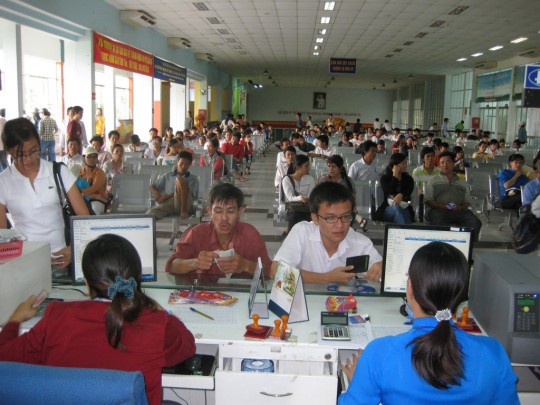
Online booking doesn't always work. So it's best to buy ticket at the station
Online booking doesn’t always work. So it’s best to buy ticket at the station
There are many ways for you to secure tickets in advance. However, booking tickets online is not one of them. Your booking would eventually get lost because of “reasons”. If possible, head to the station yourself to get the tickets a few days early. This will make sure that you get the desired seat while taking a train in Vietnam.
welcome sapa !
If you can’t make it to the station, ask the front desk of your hotel. For some extra cash, they will get you the tickets.
Prepare food and power
You can get some refreshments on the train, though I wouldn’t recommend them. They don’t cost much. They just suck. There are no breaks on the trip long enough for you to get out and buy something. So it’s best if you just pack some snack for the road. Also, there is no way to charge your phone on the train. So make sure that your devices are fully charged, and bring some backup batteries as well.
Short distance makes taking a train in Vietnam better
If you’re only planning to spend 2-3 hours on the train, there shouldn’t be any problems at all. Instead of spending many hours on a train, why not consider making multiple pit stops along the way? Our website has information on every city and province of Vietnam. So no matter where you choose to visit, there is always something worthwhile. Consider this option if you are a fan of spontaneous exploration and willing to take the time.

Thứ Năm, 5 tháng 11, 2015

The Temple of Literature ( Văn Miếu)

The Temple of Literature (Văn Miếu, 文廟) (known as Văn Miếu - Quốc Tử Giám in Vietnamese) is a Temple of Confucius in Hanoi, northern Vietnam. The temple hosts the "Imperial Academy" (Quốc Tử Giám, 國子監), Vietnam's first national university. The temple was built in 1070 at the time of King Lý Thánh Tông. It is one of several temples in Vietnam which is dedicated to Confucius, sages and scholars. The temple is located to the south of the Imperial Citadel of Thăng Long. The various pavilions, halls, statues and stelae of doctors are places where offering ceremonies, study sessions and the strict exams of the Đại Việt took place. The temple is featured on the back of the 100,000 Vietnamese đồng banknote. Just before the Vietnamese New Year celebration Tết, calligraphists will assemble outside the temple and write wishes in Hán characters. The art works are given away as gifts or are used as home decorations for special occasions.

The temple was built in 1070 and was reconstructed during the Trần dynasty (1225–1400) and in the subsequent dynasties. For nearly two centuries, despite wars and disasters, the temple has preserved ancient architectural styles of many dynasties as well as precious relics. Major restorations have taken place in 1920, 1954 and 2000.
see more other places in vietnam : things to do in ho chi minh
"In the autumn of the year Canh Tuat, the second year of Than Vu (1070), in the 8th lunar month, during the reign of King Lý Thánh Tông, the Temple of Literature was built. The statues of Confucius, his four best disciples: Yan Hui (Nhan Uyên), Zengzi (Tăng Sâm), Zisi (Tử Tư), and Mencius (Mạnh Tử), as well as the Duke of Zhou (Chu Công), were carved and 72 other statues of Confucian scholars were painted. Ceremonies were dedicated to them in each of the four seasons. The Crown Princes studied here."
In 1076, Vietnam's first university, the "Quốc Tử Giám" or Imperial Academy, was established within the temple to educate Vietnam's bureaucrats, nobles, royalty and other members of the elite. The university remained open from 1076 to 1779. In 1802, the Nguyễn dynasty's monarchs founded the Huế capital where they established a new imperial academy. The academy at the Hanoi temple lost its prominence and became a school of the Hoai Duc district.

You can see more: best things to do in vietnam

Under the French protectorate, the Temple of the Literature was registered as Monument historique in 1906. Campaigns of restoration were pursued in 1920 and 1947 under the responsibility of École française d'Extrême-Orient (French School of the Far East) and again after the World War II.


The King Lý Thánh Tông built the school. It was built in 1076 AD at the time of King Lý Thánh Tông. It was built as a school for the rich and royals to study because education is very important. After that, it was used as university for everyone because there weren't enough universities for everyone in Hanoi. They wanted that a lot of people would go to the school so they expanded to make more space for more people and since it was expanded for more people wanted to go to the school to study well. It was rebuilt because the wood that the kings used in the olden days had been so old that it started to break and fall apart. As the days went by, the kings kept replacing the wood and now we have replaced the wood with concrete or metal,stone and new wood. When the French ruled Vietnam at around 1945- 1954, they destroyed some parts of the temple for sick people and wounded people since the hospitals were full and there was no where for people to go when they are sick or wounded.

10 Top Tourist Attractions in Hanoi

This capital city of Vietnam once served as the headquarters of the North Vietnamese communist army. Today, it provides a beautiful and educational window into a country that is most often visited through the Southern, tropical Ho Chi Minh City, once called Saigon. Where the South is palm trees and beaches, the North is tall, sharp rocky mountains full of waterfalls, deep emerald waters with pearl farms, and a culture that is as unique as it is beautiful.
A visit to Hanoi provides travelers with a fascinating blend of East and West. There are bustling streets full of bicycles, motorbikes and cars; an elegant blend of Asian Pagodas, communist block buildings and French Colonial relics; and there are a host of fun and unique attractions in Hanoi for the adventurous traveler.
One Pillar Pagoda
If Buddhists were to build a treehouse, it would likely look a lot like this. This eleventh century temple was built by the emperor in gratitude for finally being blessed by a son. The temple was meant to look like a lotus flower blossoming from a single pillar in the pond, similar to the one seen in the prophetic dream of a child that this emperor had received. Inside, there is a small shrine to the Bodhisattva of Mercy. The current structure is a rebuild, as the French had the first destroyed after their retreat from the country.

Hanoi's West Lakeflickr/Francisco Anzola
This largest urban lake is a favorite location for tourists and Hanoi residents alike. It is where the high-end homes of Hanoi’s wealthy live, and contains a large number of hotels, restaurants, and luxury shops as well. It has been a popular location for residents here for thousands of years, and is home to one of Hanoi’s four sacred temples, as well as the oldest pagoda in the city. This pagoda, dating back to the sixth century, can be found on an island in the center of the lake. Boating, sightseeing, and shopping along the boardwalk are common activities here, and well worth the trip.
Thang Long Water Puppet Theaterflickr/charles chanThis theater celebrates a peasant art form that began in the rice paddies over a thousand years ago. Puppets were simply carved and puppeteers would stand in the water of the paddies, using it as a prop, and act out traditional activities like farming, or legends like the golden turtle and the emperor. The more modern version continues the use of water and audience participation. Traditional Vietnamese instruments perform an opera that narrates the puppets’ actions, and musicians will interact with puppets, encouraging the heroes and warning them of impending danger. Guests of the theater needn’t brave the monsoon weather that once would pour on outdoor audiences, but can sit and enjoy a meal while discovering this ancient dramatic art.

Ho Chi Minh Mausoleumflickr/archer10The final resting place of Vietnamese communist leader Ho Chi Minh sits in Ba Dinh square, the location where he read the nation’s declaration of independence in 1945. This tall, blocky pillared building is modeled after Lenin’s crypt in Moscow and meant to evoke a traditional communal house, though to many tourists it looks like a concrete cubicle with columns. Contrary to his desire for a simple cremation, the embalmed body is on display in plexiglass casing, and a dress code of long sleeves and pants is required to visit. The mausoleum is closed for a couple months around the end of the year, when the body goes to Russia for maintenance.
Ho Chi Minh Presidential PalaceBehind Ho Chi Minh’s Mausoleum is a humble stilt house, where Ho Chi Minh supposedly lived in the 60s, though some claim that it would have been too risky during the war for him to live here. The house is an interpretation of a traditional rural dwelling, and has been preserved just as Ho left it. It’s set in a well-tended garden next to a carp-filled pond. It shares grounds with the much more luxurious and impressive Presidential Palace built for the French Governor of the Indochina colony in the early 1900’s. The palace is now used for official receptions and isn’t open to the public.


Hanoi Hiltonflickr/Ken McChesneyThe Hoa Lo Prison, sarcastically coined the Hanoi Hilton by American POWs, was originally built by the French to house Vietnamese political prisoners. The North Vietnamese Army later used the prison to house prisoners of war during the Vietnam War. Well known figures such as Senator John McCain, James Stockdale and Bud Day were just a few of the many prisoners of war that spent time in this prison. Two thirds of the prison was torn down to make way for the Hanoi Towers; the rest was turned into a museum and is now a popular tourist attraction in Hanoi. In 1999 a Hilton Hotel opened in Hanoi and was carefully named the Hilton Hanoi Opera Hotel.
Vietnam Museum of Ethnologyflickr/namhoLike many colonial regions that were united by European rule, the country of Vietnam is actually a coagulation of 54 different officially recognized ethnic groups. The Museum of Ethnology strives to give a better understanding of each one, and does so quite elegantly. It is widely believed to be the best of all the modern museums in Vietnam. Displays include a combination of art, everyday objects, and historic artifacts to better tell the story of each unique culture.

Temple of LiteratureThis is one of the temples of Confucius, and home of the nation’s first university. Originally built in 1070, the temple is meant to honor all scholars. Today, calligraphists will come and write good will wishes in Han characters during the Asian New Year at the steps of the temple, to give as gifts. The temple was built to replicate Confucius’ birthplace, with five courtyards and various temples and other buildings throughout the expansive grounds. Of special note are the Stelae of Doctors, a series of over 100 carved blue stone turtles, which honor the names of all who pass the royal exams.
Hanoi's Old Quarterflickr/Andrea SchafferThe old quarter is a mesh of the old and the new, as antique narrow streets snake between old brick buildings, covered in modern motorbikes and street vendors. This region of Hanoi is a mix of French Colonial architecture and ancient temples, and sits along the shore of Hoan Kiem Lake. It is the center of many attractions in Hanoi, from temples to the water puppet show to its street market. As the quarter was designed around the market, you will find that the streets here are all named for the kind of products that were once sold along its sidewalks, from wood to silver to paper.


Hoan Kiem Lake
Known as the lake of the returned (or restored) sword, this lake marks the historical center of ancient Hanoi. The name comes from a legend in which Emperor Le Loi was given a magical sword by the gods, which he used to drive out the invading Chinese. Later, while boating on the lake, he encountered a giant turtle, which grabbed the sword and carried it down to its depths, Every morning at around 6am local residents practice traditional t’ai chi on the shore. The lake also houses Jade Island, home of the eighteenth century Temple of the Jade Mountain. The island is reachable via the red-painted and picturesque Morning Sunlight Bridge.